Example05 / 09
富人俱乐部系数 phi(k) 及其保度归一化 rho(k)
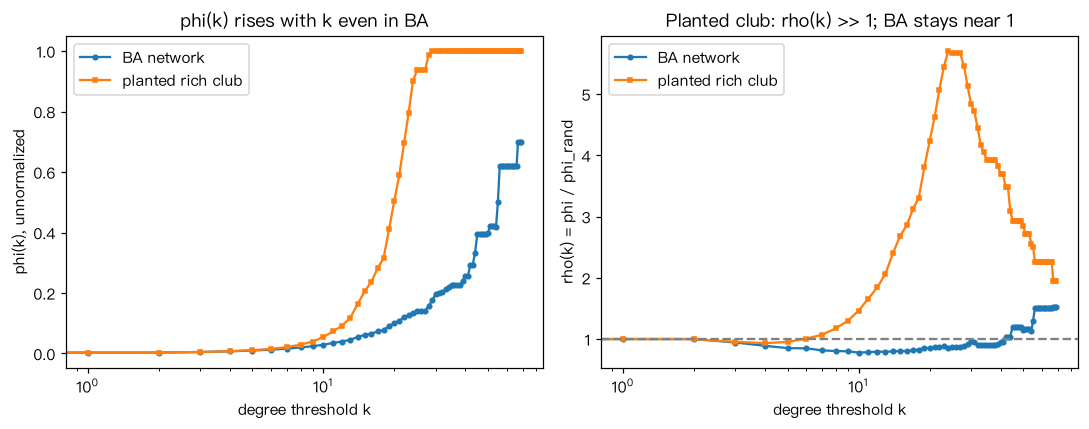
构造两张度序列相近的网络:BA 网络,以及在 BA 网络上把前 2% 高度节点之间“补齐”连接后 再用保度交换恢复原度序列的网络(植入的富人俱乐部)。 计算未归一化 phi(k) 与归一化 rho(k) = phi(k)/phi_rand(k),phi_rand 取 20 个保度随机网络的平均。 解读:即使是 BA 网络,phi(k) 也随 k 上升,单看 phi(k) 会误判;rho(k) > 1 才是富人俱乐部的证据。
Output输出图
Output文字输出
BA 网络
   k >   5: N_>k =  577, phi = 0.010, phi_rand = 0.012, rho = 0.85
   k >  10: N_>k =  181, phi = 0.029, phi_rand = 0.037, rho = 0.78
   k >  20: N_>k =   53, phi = 0.099, phi_rand = 0.117, rho = 0.85
   k >  30: N_>k =   27, phi = 0.197, phi_rand = 0.203, rho = 0.97
   k >  40: N_>k =   18, phi = 0.255, phi_rand = 0.268, rho = 0.95
   k >  60: N_>k =    7, phi = 0.619, phi_rand = 0.410, rho = 1.51
植入富人俱乐部
   k >   5: N_>k =  577, phi = 0.011, phi_rand = 0.012, rho = 0.95
   k >  10: N_>k =  181, phi = 0.055, phi_rand = 0.037, rho = 1.46
   k >  20: N_>k =   53, phi = 0.505, phi_rand = 0.120, rho = 4.22
   k >  30: N_>k =   27, phi = 1.000, phi_rand = 0.207, rho = 4.83
   k >  40: N_>k =   18, phi = 1.000, phi_rand = 0.270, rho = 3.70
   k >  60: N_>k =    7, phi = 1.000, phi_rand = 0.443, rho = 2.26
Code代码
# 构造两张度序列相近的网络:BA 网络,以及在 BA 网络上把前 2% 高度节点之间“补齐”连接后
# 再用保度交换恢复原度序列的网络(植入的富人俱乐部)。
# 计算未归一化 phi(k) 与归一化 rho(k) = phi(k)/phi_rand(k),phi_rand 取 20 个保度随机网络的平均。
# 解读:即使是 BA 网络,phi(k) 也随 k 上升,单看 phi(k) 会误判;rho(k) > 1 才是富人俱乐部的证据。
import numpy as np
import networkx as nx

G0 = nx.barabasi_albert_graph(2000, 3, seed=4)
deg0 = dict(G0.degree())

# 植入富人俱乐部:把度最高的 40 个节点两两相连,再为每条新边删去一条“枢纽-低度节点”边并
# 把被拆开的低度端点两两接上,近似保持度序列(剩余偏差很小)。
rng = np.random.default_rng(0)
G1 = G0.copy()
hubs = sorted(G1, key=lambda x: deg0[x], reverse=True)[:40]
hubset = set(hubs)
for i in range(len(hubs)):
    for j in range(i + 1, len(hubs)):
        a, b = hubs[i], hubs[j]
        if G1.has_edge(a, b):
            continue
        na = [x for x in G1[a] if x not in hubset]
        nb = [x for x in G1[b] if x not in hubset]
        if not na or not nb:
            continue
        x, y = rng.choice(na), rng.choice(nb)
        if x == y or G1.has_edge(x, y):
            continue
        G1.remove_edges_from([(a, x), (b, y)])
        G1.add_edges_from([(a, b), (x, y)])
assert dict(G1.degree()) == deg0                     # 度序列严格不变


def rich_club(G):
    return nx.rich_club_coefficient(G, normalized=False)


def rich_club_rand(G, n_null=20, seed=0):
    acc = {}
    for s in range(n_null):
        H = G.copy()
        m = H.number_of_edges()
        nx.double_edge_swap(H, nswap=10 * m, max_tries=1000 * m, seed=seed + s)
        for k, v in rich_club(H).items():
            acc.setdefault(k, []).append(v)
    return {k: np.mean(v) for k, v in acc.items()}


curves = []                                         # 保存 phi 与 phi_rand 用于作图
for name, G in [("BA 网络", G0), ("植入富人俱乐部", G1)]:
    phi = rich_club(G)
    phi_r = rich_club_rand(G, n_null=20, seed=10)
    curves.append((phi, phi_r))
    print(name)
    for k in [5, 10, 20, 30, 40, 60]:
        if k in phi and phi_r.get(k, 0) > 0:
            n_rich = sum(1 for _, d in G.degree() if d > k)
            print(f"   k > {k:3d}: N_>k = {n_rich:4d}, phi = {phi[k]:.3f}, phi_rand = {phi_r[k]:.3f}, "
                  f"rho = {phi[k] / phi_r[k]:.2f}")

# 作图:未归一化 phi(k) 与归一化 rho(k) = phi / phi_rand
import matplotlib.pyplot as plt
fig, ax = plt.subplots(1, 2, figsize=(10, 4))
for (phi, phi_r), lab, mk in zip(curves, ["BA network", "planted rich club"], ["o", "s"]):
    ks = [k for k in sorted(phi) if phi_r.get(k, 0) > 0 and sum(1 for _, d in G0.degree() if d > k) >= 5]
    ax[0].plot(ks, [phi[k] for k in ks], marker=mk, ms=3, label=lab)
    ax[1].plot(ks, [phi[k] / phi_r[k] for k in ks], marker=mk, ms=3, label=lab)
ax[0].set_ylabel("phi(k), unnormalized"); ax[0].set_title("phi(k) rises with k even in BA")
ax[1].axhline(1, color="gray", ls="--"); ax[1].set_ylabel("rho(k) = phi / phi_rand")
ax[1].set_title("Planted club: rho(k) >> 1; BA stays near 1")
for a in ax:
    a.set_xscale("log"); a.set_xlabel("degree threshold k"); a.legend()
plt.tight_layout(); plt.show()Run在浏览器中运行
首次加载 Python 环境约需 20–40 秒;可以修改参数后重新运行。